Node.
Node.
Node.
Overview
Overview
The UK government wants savers to become investors. Node makes the first move small enough to take: it turns loyalty points people already earn into fractional shares of those same brands. From there the service builds toward real cash investment through targeted support and peer evidence.
Designed in response to a brief from EY Studio+, at the Royal College of Art.
The UK government wants savers to become investors. Node makes the first move small enough to take: it turns loyalty points people already earn into fractional shares of those same brands. From there the service builds toward real cash investment through targeted support and peer evidence.
Designed in response to a brief from EY Studio+, at the Royal College of Art.
The UK government wants savers to become investors. Node makes the first move small enough to take: it turns loyalty points people already earn into fractional shares of those same brands. From there the service builds toward real cash investment through targeted support and peer evidence.
Designed in response to a brief from EY Studio+, at the Royal College of Art.
Timeline
Timeline
Oct - Dec 2026
Oct - Dec 2026
Category
Category
Service Design
Service Design
Team
Team
4
4


Context
Context
Context
In July 2025, the Chancellor set a goal to turn the UK from cautious savers into confident investors. New reforms aimed to make investing more accessible through changes to ISAs, investment guidance and risk warnings.
In July 2025, the Chancellor set a goal to turn the UK from cautious savers into confident investors. New reforms aimed to make investing more accessible through changes to ISAs, investment guidance and risk warnings.
In July 2025, the Chancellor set a goal to turn the UK from cautious savers into confident investors. New reforms aimed to make investing more accessible through changes to ISAs, investment guidance and risk warnings.
EY asked us to explore how everyday UK savers could move from cautious saving to confident investing in a way that feels safe, inclusive and relevant to their goals.
EY asked us to explore how everyday UK savers could move from cautious saving to confident investing in a way that feels safe, inclusive and relevant to their goals.
EY asked us to explore how everyday UK savers could move from cautious saving to confident investing in a way that feels safe, inclusive and relevant to their goals.
The brief was explicit that this was a behaviour change project, not a product brief.
The brief was explicit that this was a behaviour change project, not a product brief.
The brief was explicit that this was a behaviour change project, not a product brief.
Research
Research
Research
We interviewed cash ISA savers to understand what was holding them back.
We interviewed cash ISA savers to understand what was holding them back.
We interviewed cash ISA savers to understand what was holding them back.
We found that the barrier wasn’t financial. It was emotional.
We found that the barrier wasn’t financial. It was emotional.
We found that the barrier wasn’t financial. It was emotional.
"The risk of losing money frightens me"
"The risk of losing money frightens me"
Loss feels more real than the invisible cost of inflation.
“Research is overwhelming, and who’s going to validate if I made a good choice?”
“Research is overwhelming, and who’s going to validate if I made a good choice?”
Lack of confidence makes investing feel overwhelming.
“I was too busy, so I asked my brother to find out the best options.”
“I was too busy, so I asked my brother to find out the best options.”
People rely on trusted networks to navigate financial decisions.
“I started investing because my friends were doing it.”
“I started investing because my friends were doing it.”
Social influence can be a stronger trigger than financial education.
Four key barriers emerged:
Four key barriers emerged:
Lack of personalized reassurance
Lack of personalized reassurance
Lack of personalized reassurance
Fear of making the wrong decision
Fear of making the wrong decision
Fear of making the wrong decision
Present bias
Present bias
Present bias
Choice overload
Choice overload
Choice overload
From Savers to Investors
From Savers to Investors
We mapped the journey from saver to investor through five behavioural states rather than a traditional funnel.
We mapped the journey from saver to investor through five behavioural states rather than a traditional funnel.
We mapped the journey from saver to investor through five behavioural states rather than a traditional funnel.
This became the framework for the project and helped us define where to focus.
This became the framework for the project and helped us define where to focus.
This became the framework for the project and helped us define where to focus.
Mental Decoupling
Mental Decoupling
Inertia Breakdown
Inertia Breakdown
Trust Building
Trust Building
Habituation
Habituation
Investor Empowerment
Investor Empowerment
Where the switch happens
The Switch happens as inertia breaks down and trust begins to build.
The Switch happens as inertia breaks down and trust begins to build.
Target Audience
Target Audience
UK young adults aged 28–36, regardless of gender
UK young adults aged 28–36, regardless of gender
UK young adults aged 28–36, regardless of gender
Hold savings in a Cash ISA, around 10K
Hold savings in a Cash ISA, around 10K
Hold savings in a Cash ISA, around 10K
Interested in financial wellbeing and investing
Interested in financial wellbeing and investing
Interested in financial wellbeing and investing
Feels disconnected from investing due to complexity and confusion.
Feels disconnected from investing due to complexity and confusion.
Feels disconnected from investing due to complexity and confusion.
Socialise mainly in local cafes, restaurants and pubs.
Socialise mainly in local cafes, restaurants and pubs.
Socialise mainly in local cafes, restaurants and pubs.

Key Design Moments
Key Design Moments
Key Design Moments
01
01
Designing for one moment instead of the whole journey
Designing for one moment instead of the whole journey
Designing for one moment instead of the whole journey
We identified six behavioural states, but focused on the gap between two of them: the moment when inertia breaks, but trust has not formed yet. We called it The Switch.
We identified six behavioural states, but focused on the gap between two of them: the moment when inertia breaks, but trust has not formed yet. We called it The Switch.
We identified six behavioural states, but focused on the gap between two of them: the moment when inertia breaks, but trust has not formed yet. We called it The Switch.
What it cost
What it cost
What it cost
We left the long-term journey unresolved. We knew that designing only for the first step would leave questions about what happens next.
We left the long-term journey unresolved. We knew that designing only for the first step would leave questions about what happens next.
We left the long-term journey unresolved. We knew that designing only for the first step would leave questions about what happens next.
Why
Why
Why
The research showed that the first move was the main blocker. The stages that follow are different problems and need different solutions. Focusing on one moment allowed us to make the intervention more concrete.
The research showed that the first move was the main blocker. The stages that follow are different problems and need different solutions. Focusing on one moment allowed us to make the intervention more concrete.
The research showed that the first move was the main blocker. The stages that follow are different problems and need different solutions. Focusing on one moment allowed us to make the intervention more concrete.

02
02
02
The first investment uses no money
The first investment uses no money
The first investment uses no money
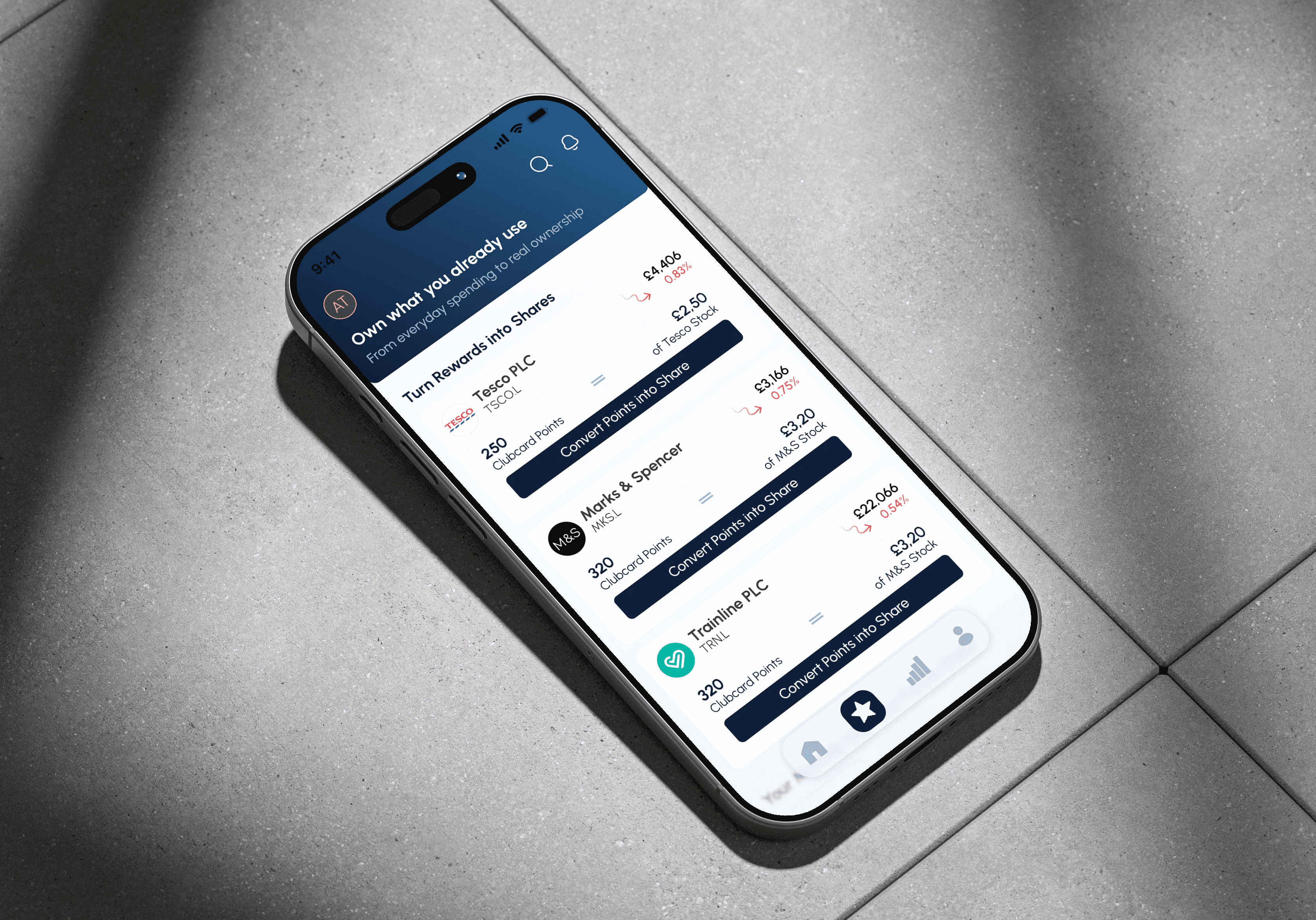
Node connects to loyalty schemes people already use, such as Tesco Clubcard and Boots Advantage. Users can choose to turn their points into fractional shares in the same brand. For example, 250 Clubcard points become £2.50 of Tesco stock.
Node connects to loyalty schemes people already use, such as Tesco Clubcard and Boots Advantage. Users can choose to turn their points into fractional shares in the same brand. For example, 250 Clubcard points become £2.50 of Tesco stock.
Node connects to loyalty schemes people already use, such as Tesco Clubcard and Boots Advantage. Users can choose to turn their points into fractional shares in the same brand. For example, 250 Clubcard points become £2.50 of Tesco stock.
What it cost
What it cost
This is the decision most open to challenge. Points are not the cash the policy aims to move into investments, so the first conversion does not directly contribute to that goal. It could be seen as a gimmick that delays the real behaviour.
This is the decision most open to challenge. Points are not the cash the policy aims to move into investments, so the first conversion does not directly contribute to that goal. It could be seen as a gimmick that delays the real behaviour.
This is the decision most open to challenge. Points are not the cash the policy aims to move into investments, so the first conversion does not directly contribute to that goal. It could be seen as a gimmick that delays the real behaviour.
Why
Why
The barrier was emotional, not financial. Starting with a trusted brand makes investing feel safe, while limited choice makes the first step easier. Confidence comes from action, not instruction.
The barrier was emotional, not financial. Starting with a trusted brand makes investing feel safe, while limited choice makes the first step easier. Confidence comes from action, not instruction.
The barrier was emotional, not financial. Starting with a trusted brand makes investing feel safe, while limited choice makes the first step easier. Confidence comes from action, not instruction.

03
03
03
Showing the cost of inaction without using fear
Showing the cost of inaction without using fear
Showing the cost of inaction without using fear
The app connects to the user’s cash ISA and makes the cost of staying still visible: at your current contribution rate, you could lose £189.80 a year to inflation. We translated this into everyday equivalents: 20 Costa coffees or 9 M&S T-shirts.
The app connects to the user’s cash ISA and makes the cost of staying still visible: at your current contribution rate, you could lose £189.80 a year to inflation. We translated this into everyday equivalents: 20 Costa coffees or 9 M&S T-shirts.
The app connects to the user’s cash ISA and makes the cost of staying still visible: at your current contribution rate, you could lose £189.80 a year to inflation. We translated this into everyday equivalents: 20 Costa coffees or 9 M&S T-shirts.
What it cost
What it cost
This sits close to a dark pattern. We were deliberately using loss aversion which is the same bias the service is designed to overcome.
This sits close to a dark pattern. We were deliberately using loss aversion which is the same bias the service is designed to overcome.
This sits close to a dark pattern. We were deliberately using loss aversion which is the same bias the service is designed to overcome.
Why
Why
The loss from inflation is invisible, so we made it visible without turning it into pressure. The screen shows the number, makes it relatable, and stops there. No countdowns, red warnings or prompts. Peer evidence sits alongside it to provide the reassurance needed to act.
The loss from inflation is invisible, so we made it visible without turning it into pressure. The screen shows the number, makes it relatable, and stops there. No countdowns, red warnings or prompts. Peer evidence sits alongside it to provide the reassurance needed to act.
The loss from inflation is invisible, so we made it visible without turning it into pressure. The screen shows the number, makes it relatable, and stops there. No countdowns, red warnings or prompts. Peer evidence sits alongside it to provide the reassurance needed to act.

The Service
The Service
The Service
Three stages, each addressing a barrier revealed by the previous one.
Three stages, each addressing a barrier revealed by the previous one.
Three stages, each addressing a barrier revealed by the previous one.
01
01
Everyday Value & First Investment
Everyday Value & First Investment
Everyday Value & First Investment
Loyalty points become fractional shares, making the first investment feel familiar and low-risk.
Loyalty points become fractional shares, making the first investment feel familiar and low-risk.
02
02
Targeted Support & Awareness
Targeted Support & Awareness
Targeted Support & Awareness
Inflation insights and peer-based suggestions help users understand when and why to invest, within the FCA’s new Targeted Support regime.
Inflation insights and peer-based suggestions help users understand when and why to invest, within the FCA’s new Targeted Support regime.
03
03
Empowered Investment & Cash Utilisation
Empowered Investment & Cash Utilisation
Empowered Investment & Cash Utilisation
Guided movement of actual cash ISA balances into larger investments.
Guided movement of actual cash ISA balances into larger investments.
Underneath is a loyalty loop: users invest in brands they already know, brands gain long-term shareholders, and more capital stays in UK companies. This turns Node from an investment feature into a service.
Underneath is a loyalty loop: users invest in brands they already know, brands gain long-term shareholders, and more capital stays in UK companies. This turns Node from an investment feature into a service.
Underneath is a loyalty loop: users invest in brands they already know, brands gain long-term shareholders, and more capital stays in UK companies. This turns Node from an investment feature into a service.

Journey Map
Journey Map
Journey Map

Impact
Impact
Impact
This is a proposal, not a shipped product, so I won’t claim outcomes it hasn’t produced. Instead, the project demonstrates the scale, viability and regulatory fit of the proposition:
This is a proposal, not a shipped product, so I won’t claim outcomes it hasn’t produced. Instead, the project demonstrates the scale, viability and regulatory fit of the proposition:
This is a proposal, not a shipped product, so I won’t claim outcomes it hasn’t produced. Instead, the project demonstrates the scale, viability and regulatory fit of the proposition:
1.12M UK savers identified as the addressable audience, using ONS and FCA data.
1.12M UK savers identified as the addressable audience, using ONS and FCA data.
1.12M UK savers identified as the addressable audience, using ONS and FCA data.
A service designed around live FCA regulation, including Targeted Support, Consumer Duty and LTAF-in-ISA changes.
A service designed around live FCA regulation, including Targeted Support, Consumer Duty and LTAF-in-ISA changes.
A service designed around live FCA regulation, including Targeted Support, Consumer Duty and LTAF-in-ISA changes.
A business case spanning four stakeholders: users, UK brands, retail banks and investment banks.
A business case spanning four stakeholders: users, UK brands, retail banks and investment banks.
A business case spanning four stakeholders: users, UK brands, retail banks and investment banks.
Reflections
Reflections
Reflections
Strengths
Embedded investment
Makes the first investment simple and familiar for non-investors.
Win-win partnership
Creates value for users, brands and financial partners.
Weaknesses
Consumer protection
Deposits and investments need the same level of protection users expect from banks.
Data privacy
Handling financial data requires strong security and trust.
Opportunities
Double impact
Can influence both investment behaviour and the UK economy.
Scalability
The model could expand beyond UK brands and markets.
Threads
Reputation risk
Poorly designed partnerships could damage brand and user trust.
Regulatory risk
Changes in financial regulation could affect how the service operates.
Learning
Learning
Learning
The biggest learning was that changing investment behaviour required more than a better interface. It required reducing emotional risk, simplifying the first step and designing within a complex financial system.
The biggest learning was that changing investment behaviour required more than a better interface. It required reducing emotional risk, simplifying the first step and designing within a complex financial system.
The biggest learning was that changing investment behaviour required more than a better interface. It required reducing emotional risk, simplifying the first step and designing within a complex financial system.
Team
Team
Beril Sungur
Beril Sungur
Yuki Yoshioka
Yuki Yoshioka

Pooja Rumale
Pooja Rumale
Siyeon Kim
Siyeon Kim